The Physics of Flight and Form: Part 2
February 20, 2026 by Benji Heywood in Instruction

You’ve certainly heard that ‘smooth is far’. You probably even believe it, in some general sense. Most likely, you find you really do throw furthest when you’re not trying to muscle it. But when the basket is just beyond your comfortable range, do you nevertheless try a bit harder (and, more often than not, throw terribly)? If so, you’re definitely not alone. Because it’s all very well being told that smooth is far, but unless you can really understand how and why, then there’s always going to be that temptation to try to add extra effort somewhere. That feels entirely sensible — when you think about it, it’s certainly pretty weird that trying less hard will make the disc fly further. So let’s discuss how “smooth” really can be “far.”
This comes in two parts: Where does the speed come from, if I’m not actively throwing the disc hard? Why does trying harder often result in less speed rather than more? The answer to the first question is straightforward, if perhaps a little surprising. Think about the momentum your body has when moving down the tee pad. What would happen if we transferred all that momentum into the disc? Momentum is mass × velocity. So if we can successfully transfer momentum from a big thing to a small thing, then the velocity is going to go up – because a lower mass will need to be multiplied by a much higher velocity if it’s to have the same momentum as before. Let’s say you weigh 70kg (~150lbs) and the disc weighs 175g. That means you have 400 times the mass that the disc has. So if you walk up at, say, 3 mph (a gentle walking pace) there’s enough momentum already in the system – if you could somehow transfer all of it into the disc – to throw at 400 times that speed, which is 1200mph!1
Of course, in the real world, we can’t transfer anything like 100% of that effort into the disc. That 1200mph figure is absurd and intended only to show you that we don’t necessarily need to actively add power to the throw. There is more than enough juice in our walk-up, or in a standstill weight-shift, to launch the thing unbelievably far, if we can get really good at transferring momentum. Now, on to the second question. Sure, there’s plenty of energy already in the system, but why does adding a bit more effort tend to make things go slower? To answer that, we need to think about the mechanism by which the momentum is transferred.
A common way to ‘explain’ efficient momentum transfer in your throw is to compare it to a whip. To crack a whip, you can get the whole thing moving and then stop one end of it.2 As each bit of the whip goes past the stopped bit and, in turn, gets stopped itself, it passes on some of its momentum to the part of the whip that is still moving. What started out as the mass of the whole whip moving (with whatever momentum that had) becomes an increasingly tiny piece of remaining whip-tip, with a good proportion of its momentum intact, and so it travels very, very fast at the end.3
But there’s a big piece missing here. It’s all very well to say that momentum is transferred along the whip, but how? What mechanism allows the momentum of one part of the whip (as it slows down) to be passed on to the next part (thereby speeding it up)? How does a whip transfer momentum? And how can you transfer momentum within your throwing motion? This is a question that’s often ignored, but it’s crucial in understanding why trying harder might not let you throw faster. In a way, you can think about a whip as a long series of tiny levers. It’s easier to think about how those levers work on a slightly bigger scale, with just one ‘lever’ to worry about. We’re just talking here about freely-moving connected levers, on a massively bigger scale than inside a whip.
Consider a three-section hinged stick. We’ll call the sections handle, lever, and tip. How exactly are we going to transfer momentum from one part to another?
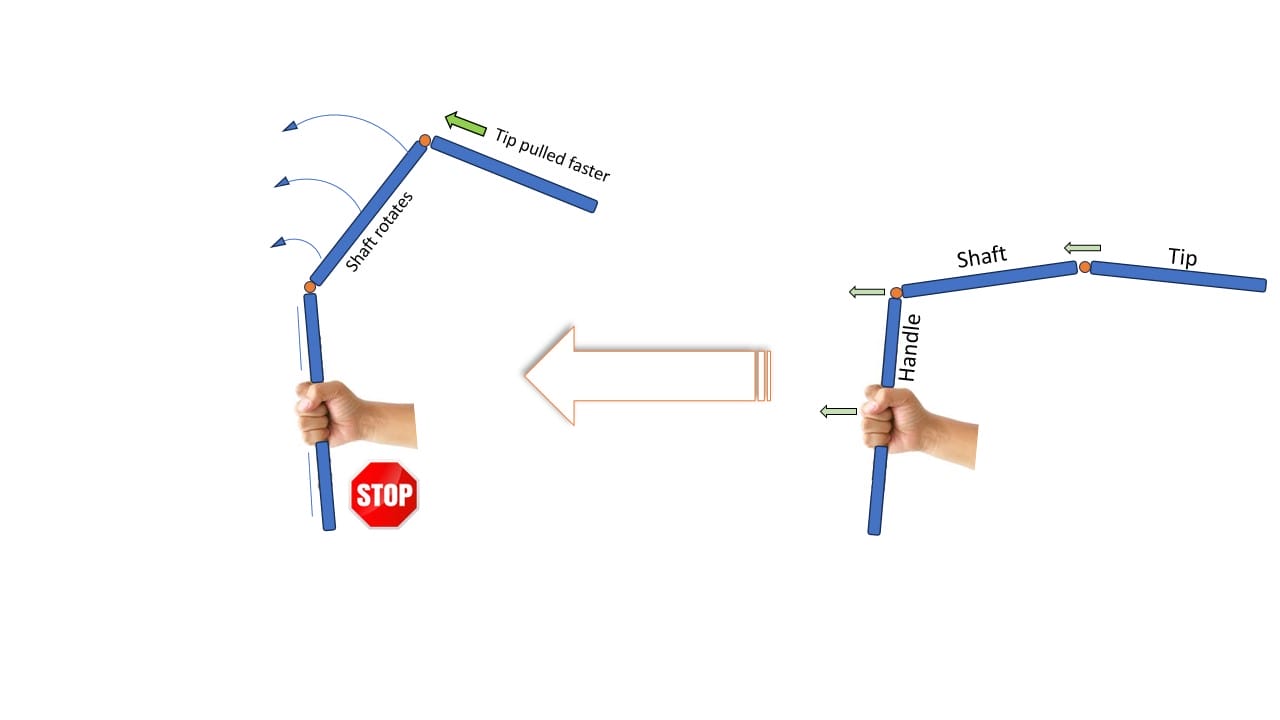
Hold the handle, accelerate it forward until the whole thing is moving, and then stop the handle. The other parts of the stick still have momentum and will carry on forwards, swinging around in front of the stopped part. The lever is the interesting bit. One end of it is connected to the stopped handle, so that end has to stop. But as a whole, the lever (or more specifically its center of mass) will want to carry on at roughly the same speed.4 It’ll pivot around that stopped end.
But think what this means for the far end of the lever. One end of it is (pretty much) stationary, but the center of mass is moving at roughly the same speed as before, so the far end will be going faster than before, as you can easily see in the video. Why? Because being further away from the point of rotation means you have further to travel – the bigger the circle, the longer its circumference. We’re dealing with a rigid lever, so if the middle of it is doing (for example) one rotation per second around the pivot point, then so is the far end. Which means the far end must be traveling faster, in order to traverse that longer circle in the same time.
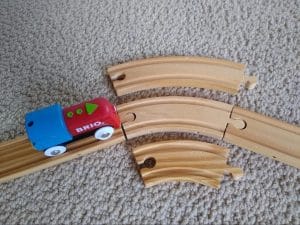
But what is that far end connected to? The third part of the stick, the tip! So the end of the lever, trying to go faster, will be pulling on the tip, causing the tip to accelerate (and, of course, causing itself to decelerate, since every action has an equal and opposite reaction). After a time, the lever slows right down, but in doing so it has transferred at least some of its momentum into the tip – which is pulled through faster than it had been going before. And then of course the tip does the same thing, overtaking – and rotating around – the slowing lever. The end of the tip now goes much faster than any part of the lever or handle ever did. Now, if we imagine adding more and more hinges, splitting the stick into more and more sections, we’ll eventually be imagining whipping something like a bicycle chain, with lots and lots of ‘levers’ acting in sequence between the ‘handle’ and the ‘tip’. And if we keep going, imagining more and more sections, we can picture the billions of molecular connections within a whip behaving in much the same way. A whip is like a stick with a billion hinges, with each section acting as a rotating lever that pulls on the ones behind. Momentum is transferred along the whip as each ‘lever’ spins around. But of course, it’s not really so simple as each individual hinge or lever acting one after the other. As soon as a lever starts to rotate, it will pull on the next lever in an arc, not a straight line. Which means the next lever – initially pulled off-line even before it gets pulled forward, and also constrained by its connection to yet more levers further up the chain – will do some interestingly non-linear things. There’ll be complex interactions going on, and the whip will curl and curve.5
Levers much further down the chain will start to be affected well before it’s “their turn” to transfer momentum onwards. The timing is incredibly intricate and – crucially – will naturally happen in a very efficient way. Remember that a real whip has no additional energy added after the initial motion; there are no muscles or other sources of power along the length of it. It simply transfers some of the momentum you started with, and yet still generates incredible speed. If we let the various levers whip how they naturally want to,6 efficiency can just happen. All this has implications for our (somewhat) whip-like throw, and can help us to understand why additional (misdirected) effort will make us throw slower.
There are at least three ways to mess things up:
1. Actively moving something too soon, so that it races ahead of the levers that were supposed to accelerate it later on. There’ll inevitably be a lot of jerky inefficiency when the rest of the whip ‘catches up’.7
2. Actively keeping something moving when it should naturally be slowing down. Slowing and/or stopping are vital parts of the motion – the next lever can’t rotate if it isn’t allowed to overtake and, as we showed above, that rotation is the key mechanism by which it accelerates the ones further down the chain. Just stiffly resisting any of the subtle movements and counter-movements that make a whip work. It’s not obvious what should move and when – think about how a real whip loops and curls, with individual segments often going in the ‘wrong’ direction earlier in the motion. Your conscious brain, trying to impose some sensible, simple, linear sequence of motions, will mess up the necessary complexity that makes the whip efficient. Fundamentally, each lever has to be allowed to move, whenever it gets pushed and pulled by other parts of the whip.
3. Almost anything you actively do, once the whip is whipping, will negatively impact your throw. For 99% of us, it’s hugely important to let some of those hinges stay relatively loose8 and let the levers be guided to where they need to be.9 Only when you have a consistent throw, and your body intuitively knows what moves where, can you begin to add meaningful power late in the throw – because that added power must work with the natural motions rather than fight them. Consciously adding effort, using your arm muscles somewhere in the process, will mess up the whip for most people. And the whip, I hope we can all agree, is crucial. Good form beats muscle. And smooth really is far.10
There’s lots of caveats here, of course. I’m not trying to present a realistic calculation. But fundamentally, there is at least that much momentum in the system – and that’s before we include other sources of energy like the vertical aspects of bracing, or the tension and springiness in your body, or the energy in your muscles and so on. ↩
Yes, I know this is a huge simplification. Bear with me for now. ↩
Whips are also tapered, which amplifies the effect significantly as each section has lower mass per unit length than the one before, and indeed you’ll often see the tapering used as the sole explanation for why you can crack a whip. But of course you can whip an ordinary rope and get the end of it moving pretty fast – not as fast as a tapered whip, but certainly much faster than the speed you originally put into it. Besides, the average human actually is slightly tapered from body to arm to wrist, and this fact is often referenced in other sports when they’re talking about the kinetic chain. ↩
Stopping one end (as long as the hinge is fairly frictionless) won’t actually slow it down much – it’ll just change the direction. Imagine a roller-skater grabbing a lamp-post with an outstretched arm as they skate by. They’ll be pulled around in a circle (changing the direction of their velocity) but they won’t change their (directionless) speed much – all the force is being applied perpendicular to their direction of travel so it won’t affect how fast they’re going. It’s perfectly possible for them to go 180 degrees around the lamp-post and head back to where they came from. Or imagine throwing a ball towards a U-shaped wall – you can get it to go all the way around and fly back towards you. Its velocity is opposite to before, but its speed hasn’t actually changed much. ↩
Perhaps here is a good place to admit the simplifications involved in this model. In a whip, it’s actually the curve that travels along the whip faster and faster – more like a wave traveling down the whip, in some ways – and it looks nothing whatsoever like a one-after-another series of individual links. Nevertheless, the key thing in the momentum transfer is that something (whether a link or a long chain of tiny links forming a curve in the whip) rotates around and pulls on the bit behind. ↩
Only if they start from a more or less ‘correct’ starting position, obviously! Tucking the disc much too far behind you as you start the swing, for example, tends to cause rounding if you allow things to move ‘the way they want to’ from there. This does not make for an efficient whip no matter how smoothly you throw. ↩
The best analogy I can think of for this is towing a friend’s broken-down car on a rope (rather than using a stiff rod or other non-slack attachment). It can be a horribly jerky experience if the towed car ever goes faster than your vehicle, because it creates slack in the rope. That allows your car to suddenly accelerate, since it doesn’t have the weight of the other car to pull, but then it ‘catches’ the other car as the rope goes taut and causes a sharp deceleration (and speeds up the towed car, creating slack, and so on for a while until both drivers find a way to equalize the speed). You can think of something similar in the arm – if (for example) your lower arm gets ahead of the proper sequence, then instead of the upper arm pulling on the lower arm smoothly, it’ll accelerate too much (when pulled by the shoulders) and then be jerked back when it catches up to the lower arm and encounters resistance again. That jerk reverberates up and down the chain, and is not going to be helpful. ↩
I don’t mean completely floppy (particularly when we’re getting things into the right position earlier in the throw). It’s easy to think that the arm muscles have to be either maximally powerful or completely uninvolved, but of course there’s plenty of options in between those two extremes. When you throw a ball, your arm joints are neither floppy nor stiff, but somewhere in between – active rather than passive, but relaxed rather than tense. We want the same thing here – using smaller muscles or smaller efforts to keep some control of the motion, but not trying to brute-force the whole throw with the major muscle groups of the arm (at least until we have fully learned where and when to apply that force). ↩
To make myself absolutely clear – I’m not saying that the throw is simple, or that the position of the different bits of your body isn’t important, or that your muscles play no part, or that gravity or the springiness in parts of your body can’t contribute. This is not an article about the intricate detail of how to throw, and I’m not suggesting that every aspect of the throw is directly analogous to a whip. I’m just trying to explain something that is already widely understood: that most amateurs really can throw better when they don’t try to actively add speed to the disc. ↩
The annoying thing, from a coach’s perspective, is that it’s perfectly possible to throw at least 250-350 feet by actively rotating, by muscling the disc, by doing almost everything “wrong.” So the need to be smooth and balanced, to focus on correct momentum transfer, is much less obvious than it would otherwise be. If you practice enough, you can be a pretty decent amateur disc golfer without anything close to efficient form, and it’ll be hard to go back to the drawing board and start again. And if you’re having fun, then why bother? Well, since you ask, a very good reason to have efficient form rather than effortful form – even if both produced identical results – is that efficient throwing will put far, far less strain on your body. You might not care about that very much when you’re 25 and feeling invincible, but it’s a safe bet that you’ll care eventually. ↩