The Physics of Flight and Form: Part 1
December 17, 2025 by Benji Heywood in Analysis, Instruction
It’s not trivial to explain why a disc turns and fades. And it seems that everyone has their own theories about what’s really going on, some of which are, of course, very wrong. In truth, describing every aspect of why it happens is the stuff of serious scientific papers – but I do think it’s possible to explain the basics, for the general reader, in a clear enough way as to debunk some of the misconceptions.
And that’s the goal for this post – to explain things in a way that provides enough knowledge to be able to make informed adjustments in disc choice or throwing angles, rather than basing everything on misunderstandings.
Let’s get into it. Why does a disc both turn and fade in the same throw? On the face of it, this is a bit odd. All the things that were happening to it at the beginning of the throw – forward motion, lift, drag, spin – are all still acting in the same direction at the end. Even if these factors have declined during the throw, they certainly haven’t reversed direction – but whatever was causing turn has somehow reversed its effect and is now causing fade.
So, what property of flight actually changes to cause such a switch in the behavior of a flying disc? The answer, perhaps surprisingly to many people, is nose angle. What really causes an early-turning disc to start fading later on is not the change in speed (or at least, not wholly, and not directly). It’s the change in the nose angle.
It’ll take us this entire article before we’re able to discuss the real relationship between turn, fade, speed, and nose angle. Strap in.
The Basics of Turn and Fade
There are, in the simplest terms, just a couple of things we need to worry about to explain why a disc turns and fades. One is lift, the aerodynamic force that keeps a flying disc in the air longer than a brick. The other is a fundamental concept in rotational physics, which I won’t attempt to explain in writing — you kind of need to see it happening. Fortunately, Bill Nye to the rescue, demonstrating the key concept we’ll need:
That reaction-at-a-right-angle thing is central to our problem. Turn and fade don’t happen to a spinning disc because of a force pushing up on one side or the other. Rather, they happen because there is a lift force pushing up the front or the back of the disc, and the physics that Bill was demonstrating means that the effect is turned 90 degrees in the direction of rotation. The disc will turn or fade, depending on whether the back or the front of the disc is being pushed up. Weird, right? But watch the video again if you doubt it – when the ground pushes up on one side of his frisbee, it’s the nose instead that goes up and it starts to fly again. When something tries to twist a spinning thing, the effect is offset by 90 degrees.
Already we’re in a position to debunk a couple of common theories. Some people believe that turn is caused because one side of the disc is spinning forwards (hence hitting the air faster) and one side is spinning away from the target (hence going slower). The idea is that this difference in speed causes a difference in lift force, which in turn causes the faster side to rise.1
In fact, any such difference in lift is negligible. But I don’t need to persuade you of that. The video above should already tell you that higher lift on one side of a spinning disc would not actually lift that side – the effect would be offset by 90° and it would be the nose that moved.
A second relatively common misconception is that more spin causes more turn. This is obviously related to the ‘differing lift’ theory and can be refuted in the same way. If there were any measurable effects like this, then more spin would mean more nose up, not more turn. In fact, more spin reduces both turn and fade, due to the increased gyroscopic stability.
The Center of Lift
Let’s talk about lift. It’s obvious that discs in flight generate lift, due to their wing shape.2 That’s why they fly further than bricks: the lift force is opposing gravity and so it takes a lot longer for the disc to fall to earth. And just as we can talk about a ‘center of gravity’ — right in the middle of the disc — we can also define a ‘center of lift’.3 And the center of lift (COL) is not necessarily in the same place as the center of gravity (COG) — sometimes it is, but more often it will be either behind or in front.
If gravity and lift happen to be acting in the same place, then they cumulatively apply no twisting force to the disc and it will continue flying in the same orientation. But if the lift is acting away from the COG, it will try to re-orient the disc – with gravity pulling down in the center, and lift pushing up somewhere behind or in front, there is a resultant twisting force trying to push the nose up or down. And that’s what would happen if the disc wasn’t spinning: it would stall out immediately or it would nose-dive.
But as we’ve said, the spinning disc means the effect of the twisting force is expressed at a right angle to the force applied! If the lift is acting from behind the center of gravity, the disc will try to turn, and if it’s acting in front of the COG, then the disc will want to fade.
What About the Magnus Effect?
This is perhaps a good time to talk about another mistaken theory of turn – the Magnus effect. This is the force that makes a spinning ball move sideways, because one side is spinning towards the direction of travel, and one side is spinning away.4 This difference in speed, and its impact on the way the air molecules interact with the surface, causes a difference in pressure from one side to the other, and the ball moves sideways.
But the effect is generally negligible on a disc, because the side of the disc isn’t presenting a very large surface – slightly larger on a very deep putter than on a driver, but still a very small side-surface compared to a ball. And once again, I don’t even need to persuade you that the effect is negligible because a Magnus force wouldn’t twist the disc. It would only push it sideways.
Not every force acting on a spinning disc acts at a right angle. Gravity, for example, still pulls the disc down – spin is not a way of creating anti-gravity! It’s only forces that try to twist the disc5 (for example, gravity acting in one place and lift in another) that are affected by the spin. Magnus can push the disc sideways (though normally a negligible amount) but can’t cause it to turn.6
Why Does the Center of Lift Move?
That’s enough debunking. But I think we can still go a bit further into things, and in particular it’s useful — genuinely useful, on the course, with wind and hills and disc choices to be made — to know a just a little more about why the center of lift moves around.
What determines the location of the COL? The lift is created as air flows over the moving disc, so you won’t be too surprised to hear that any changes in that airflow will change the way the lift force behaves. The physics of all this is quite well understood in theory but is often very complicated to model in practice — so complicated that people still regularly use wind tunnels to study how air flows over an object rather than calculating it. If Formula 1 teams are spending millions on wind-tunnel tests instead of just doing the math, then you’d better believe it can be complex stuff. There are some excellent scholarly articles on the aerodynamics of flying discs for those who want them, but our goal here is only to give disc golfers a working understanding of what’s happening.
So we’ll try to think of it in a way that makes some intuitive sense (even if it’s a somewhat inaccurate and incomplete description). One fundamental aspect of the airflow we can easily picture is whether most of the air — the air that’s being pushed out of the way as the disc flies through it — goes over the disc or under the disc.
It turns out7 that as we change the ratio of displaced air traveling under or over, we’re going to see the COL moving towards the front or the back of the disc.8 And the two things that most impact how the air is split into ‘above’ and ‘below’ streams are — fairly obviously, when you think about it9 — the shape of the disc and the angle at which it hits the air.
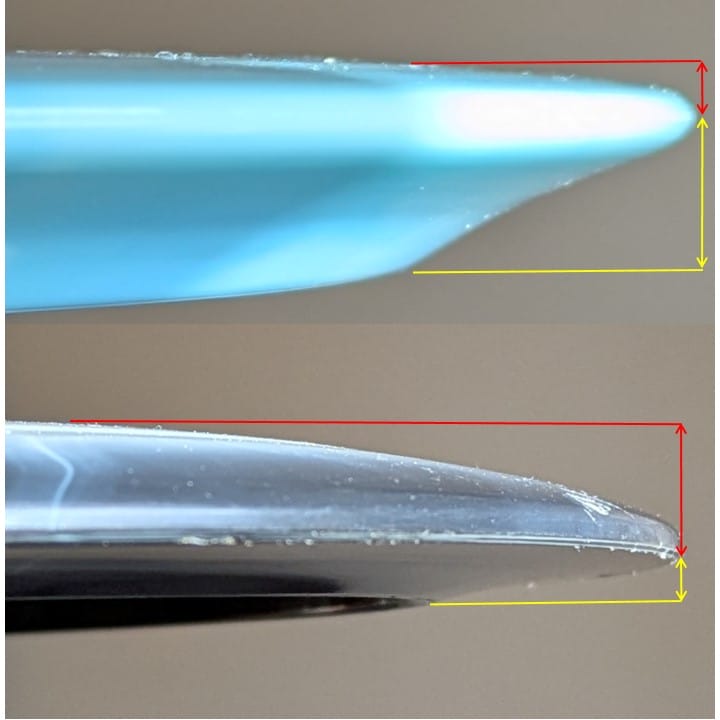
A Tilt, with a very high parting line height, diverts almost all the air underneath itself during horizontal flight. Whereas a Bolt, with a much lower PLH, diverts significantly more air over the top. It’s not surprising to see very different flight characteristics for these two discs.
But, of course, not all flight is horizontal.
Clearly if something is thrown nose-down enough, even an overstable mold, then a lot of the air is going to hit the top, no matter where the parting line might be. And if a disc, any disc, is sufficiently nose-up, then most of the air is going to go under it.
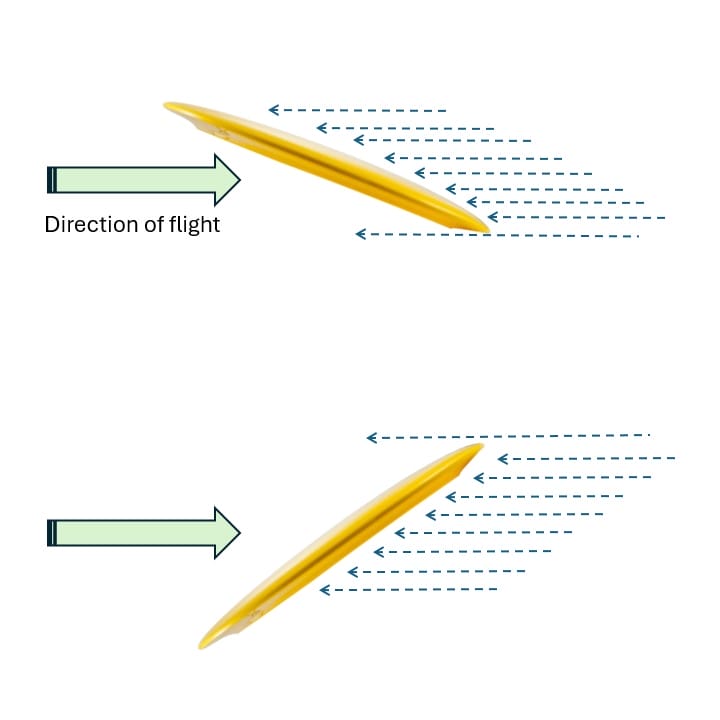
But let’s be a bit more precise about what we mean by nose-up or nose-down. We’re talking only about the air that the disc is hitting being pushed over or under the disc, and so it doesn’t actually matter how the disc is oriented to the ground – only how it is oriented to the air it’s hitting, or (equivalently10 ) how it’s oriented to the direction it’s traveling in. For this reason, we’ll use the more technical terms ‘Pitch’ (how much the nose is up or down relative to the ground) and ‘Angle of Attack’ (how much the nose is up or down relative to the air it’s hitting).
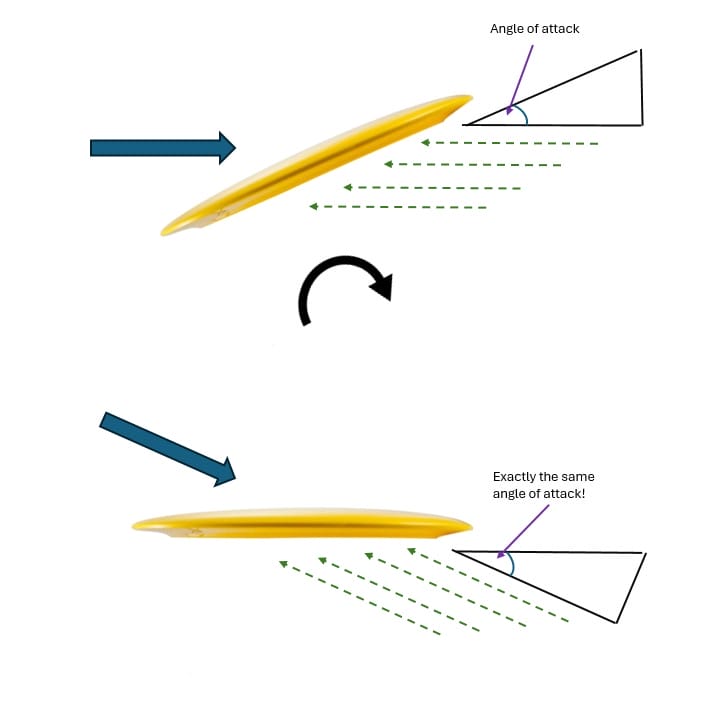
The lower part of this image is exactly the same as the top one, but rotated. A disc traveling horizontally which looks nose up (i.e. is pitched up) can have the same angle of attack (AOA) to the air it hits as a disc that looks nose-neutral but is traveling downwards.
OK, then Why Does Speed Affect Turn and Fade?
We’re now in a position to explain why speed appears so closely tied up with turn and fade, even though it doesn’t directly affect it.11 Speed changes the angle of attack.
When the airspeed is high, there’s more lift — hitting the air faster means stronger aerodynamic forces. So early on, at high speed, the lift will fight gravity much more strongly, perhaps even overcoming gravity completely and causing the disc to rise.12 The AOA will be very low (often negative) at the start and will then increase rapidly later on, because lift is declining and allowing gravity to take over.13
This is why we think of discs being too overstable or understable “for my arm speed.” All things being equal, more speed means more lift, which really does mean more turn and less fade.
But all things are not equal. Declining lift is not the only thing that affects angle of attack – obviously, the orientation of the disc comes into play also. If the disc is pitched up or down at release, then the true AOA will be higher or lower by that amount, throughout the flight. The pitch of the disc doesn’t generally change an awful lot during the flight.
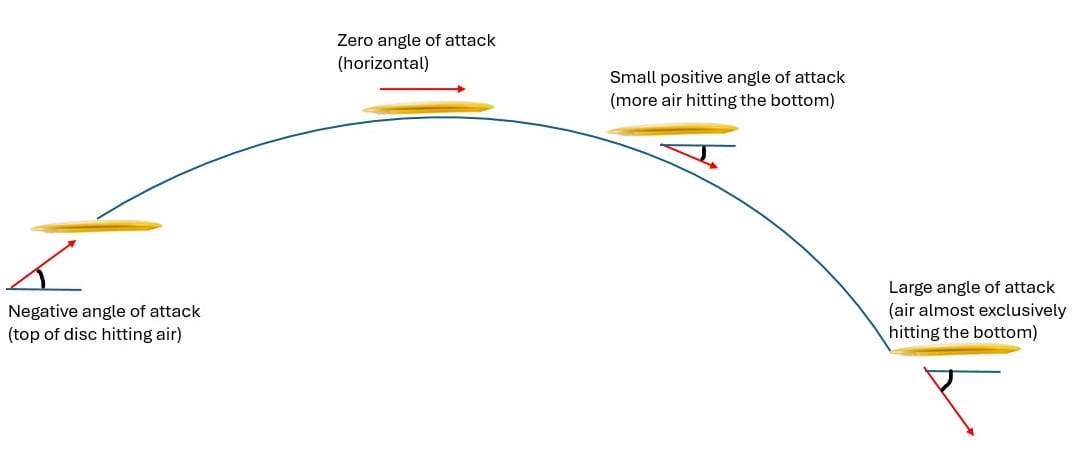
This picture shows a disc that starts out flat (not pitched up or down), and thrown upwards (or generating enough lift) so that it starts with a negative angle of attack.14 The path of the disc means that AOA increases throughout the flight. If the disc had started on the same trajectory, but initially pitched more up or down, the true AOA would be higher or lower throughout, by that constant amount (though AOA would still increase all the way) and so the amount of turn and fade would be very different.
This changing AOA will always tend to move the center of lift towards the front of the disc as the flight goes on, changing early turn to late fade.15 The choice of disc, and the initial AOA out of the hand, will change how much a disc turns before it fades, or if indeed it turns at all (or, come to that, whether it hits the ground before it has a chance to fade). But the pitch of the disc doesn’t really change much during the flight — it’s the changing trajectory of the disc, and its effect on the angle of attack, that causes early turn to become late fade.
You can probably see by now why it’s so common to talk about high speed turn and low speed fade. It’s much simpler, even if it’s not the whole picture, and for a given throw (i.e. all the other variables like launch angle, initial AOA, and disc shape are held constant) it’s true that
- higher speed -> more lift -> lower angle of attack -> more turn
- lower speed -> less lift -> higher angle of attack -> more fade
So for most purposes, speed is a good proxy for angle of attack.
But — and it’s a big but — talking only about speed disguises the importance of nose angle. You could in reality make a very slow throw turn, or a very fast throw fade, if you could get a suitably extreme initial angle of attack on it. The initial nose angle is hugely important to the shape of the throw and can have every bit as much impact on turn and fade as your choice of disc or the speed of your throw. Angle of attack can temporarily turn a Zone into a Rollo – and vice versa.
And that’s useful information. If you made it through all that technicality, then perhaps you learned something worth knowing!
This speed difference has a very real effect in helicopters, where one blade – rotating forwards – really is traveling through the air faster than an opposite blade rotating backwards. But the same is not true in the case of a symmetric disc.
Here’s why. It is true that one side of the disc is traveling faster, in terms of the actual plastic molecules in the disc. But the shape that hits the air does not hit the air any faster on one side than the other, and it’s this wing-shape pushing the air out of the way that matters most for the aerodynamics. The shape that the air hits is identical on both sides, and so there’s no meaningful difference in lift.
There is a slight difference in the way that air molecules interact with the material surface of the disc on the faster or slower side, and this has a really tiny effect on the aerodynamics. But it’s not remotely like the case of a helicopter, where one whole blade-shape is physically going through the air faster than the opposite blade. To get the same effect with a disc, we’d have to throw two discs attached to opposite ends of a stick, spinning that whole assembly so that one disc-shape actually was hitting the air faster than the other. ↩
Well, partly. A disc will usually generate a good amount of its lift due to the wing shape. But anything hitting the air very nose-up would experience lift whether it was wing-shaped or not – stick your hand out of a moving car, roughly horizontal, then change the angle a little up or down, and you’ll feel plenty of upward or downward force without any kind of wing shape. Both kinds of lift are caused by a pressure differential, and from a physics perspective, they’re much the same thing. But intuitively they feel different, because only certain shapes get the ‘wing’ effect while nearly everything feels a pressure differential when very nose up or nose down. Discs obviously fly much better because they’re wing-shaped, but they don’t always fly solely because they’re wing-shaped. ↩
The center of gravity is an imaginary point (which for a symmetric golf disc would be right in the middle, though possibly in mid air below the flight plate!) where gravity can be assumed to act. In truth, of course, gravity is pulling down on all the different parts of the disc, but all those forces can be added up and treated as if they are acting on the center of gravity. This obviously makes calculations easier! And we can do the same with the lift forces – obviously the lift doesn’t only act at one point on the disc, but nevertheless we can sum up all the upward and downward aerodynamic forces and find a point which acts as if all the force were applied in that one place. Basically, we’re saying that if (for example) the lift force at the front edge of the disc is greater than at the back edge, the ‘average’ effect will be to push up the disc at a point somewhere in front of the center of gravity – and vice versa if the lift is stronger at the back. We’ll call that point the Center of Lift. ↩
This is not quite the same as the idea we debunked before. We talked previously about the faster side creating more lift (meaning the pressure was lower above the disc than below, sucking and/or pushing it upwards), but now we’re talking about the faster side creating a low pressure at the side, sucking the ball in that direction. This is a very real effect for a ball, obviously. ↩
Probably a bunch of physicists and engineers are screaming at me to use the word ‘torque’ but it’s not going to make things clearer for the general reader, so I won’t! ↩
If we want to be picky, I suppose it is possible for Magnus to apply a twisting force. If the Magnus vector isn’t in the same plane as the center of gravity, then it will to some extent create a twisting force in combination with the inertia of the disc. But it’s not going to be a large effect, because neither the Magnus effect itself nor the angle created with the COG can be very large – and anyway, the effect would once again be seen in the nose, not in turn or fade. ↩
Yes, this is a cop-out phrase, I’m sorry! I’m not going to attempt to explain, in an article like this, all the whys and wherefores of how the air flows over the disc – separating and re-attaching, whorling and eddying… I don’t even claim to understand it all. The reality is obviously more complicated than just splitting the air above and below (for example, the shape of the lower rim – concave versus convex – has a big effect on over- or under-stability which is not captured by this simple idea) but thinking about how the air splits is a helpful way to picture things and gives a pretty good indication of how a disc will behave. Essentially, a low pressure ‘shadow’ forms behind the front rim, and a higher pressure area forms where the air crashes into the back rim, all while the airflow over the curved top of the disc is creating low pressure and ‘sucking’ it upwards. But the details of how all that changes with nose angle, with the different wing shapes of the top of the disc, with the shape of the underside rim etc etc are way beyond what we want to go into here. ↩
If you do want a thorough look at how the air moves over a disc and the effect this has on lift and drag and pitching moment, you can look here. But it’s not for the faint-hearted! ↩
At least, it’ll seem fairly obvious by (roughly) the third time you read this article… ↩
If we ignore wind. ↩
For completeness I should add that the speed can indeed have some direct effect on the position of the center of lift, because speed itself changes airflow – how fast you hit the air does change the way the flow detaches and reattaches and can affect things. But for most discs, in most flight conditions, angle of attack is the more important factor moving the COL (as per the Hummel thesis). ↩
To be more accurate, when I say ‘rise’ I mean to move above the current trajectory. You could throw downhill off a mountain at 45 degrees, with the AOA at zero (i.e. initial pitch is also 45 degrees down) and the lift would cause the disc to rise above its initial trajectory, even though it’s not ‘rising’ in real terms, but traveling downwards the whole way. Similarly you could throw upwards so that the disc is rising anyway, due to the launch angle, but the lift could push it higher still. But that’s all too wordy to be anything but a footnote. ↩
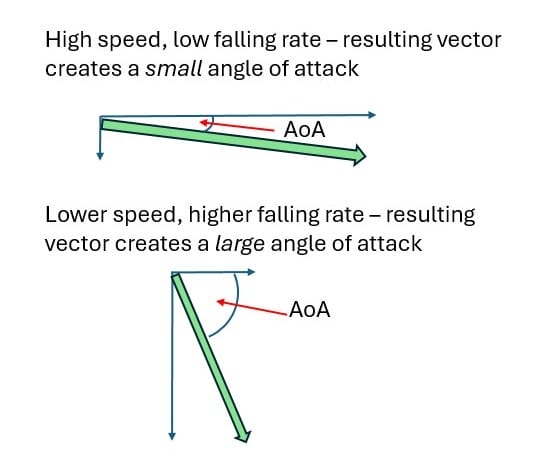
In fact, you don’t really even need to think about lift. Even if you throw an object without any kind of wing shape, the AOA will increase during flight. The speed of the object (in the direction you threw it) is at its maximum when you release it, and the rate of falling to the ground is at its minimum. Over time, the forward speed of the object goes down (due to drag), and the falling-to-earth speed increases (as gravity has its way). If you combine these vectors (forward speed and falling speed) you get the effective AOA of the object at different times in the throw, and it’s easy to see that the angle generally increases throughout the flight, since forward speed always declines and falling speed increases with time.

Lift will help to keep the AOA low for longer, sometimes allowing very straight flights (or long, controlled turns) where the AOA hardly changes for quite a long time. So it makes sense to talk about lift in the main text. But you could make a case for AOA always increasing just using gravity and drag — or even just gravity alone! ↩
For those of you with a Techdisc, the ‘nose angle’ reported in the data is the Angle of Attack, not the pitch. A disc is nose-down on Techdisc stats when it has a negative AOA, even though it is almost certainly pitched up. Only when ‘launch angle’ plus ‘nose angle’ is below zero is the disc actually pitched down, and this isn’t usually a desirable thing (unless you’re throwing steeply downhill) as it will tend to dive straight to the ground. ↩
A very overstable or understable disc may not actually exhibit both turn and fade – e.g. a Tilt might go from ‘quite a bit of fade’ early to ‘thoroughly absurd fade’ later on, because the center of lift was in front of the center of gravity even when the angle of attack was negative – and then moved even further forward. But always the direction of change during the flight of a disc is decreasing turn / increasing fade (except for some edge cases, like a sudden gust of wind, or throwing slowly down a mountain so steep that the disc actually gets faster during the flight). ↩