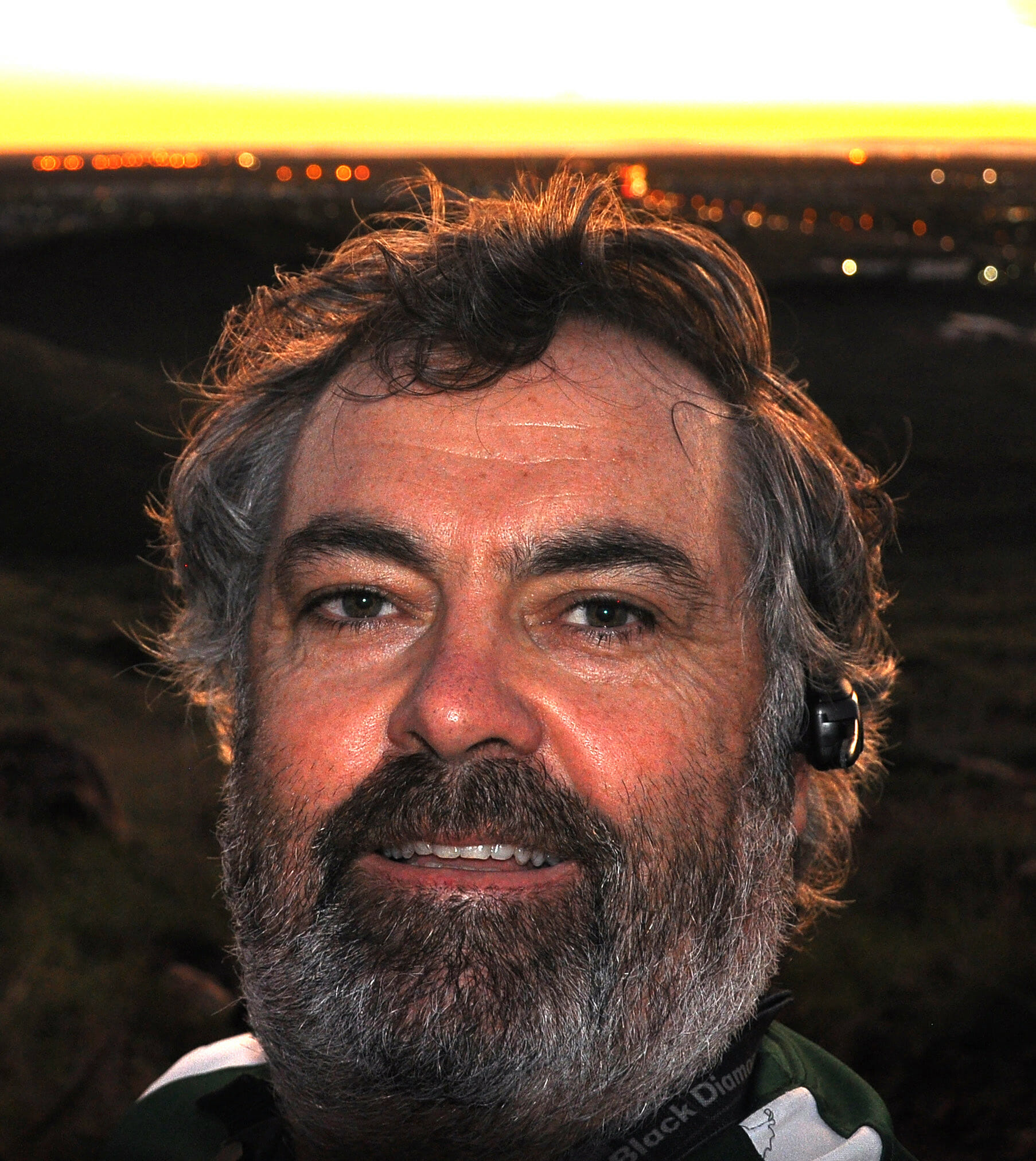
The greatest champions of the 2010s are back on top, together.
September 23, 2025 by Kingsley Flett in Analysis
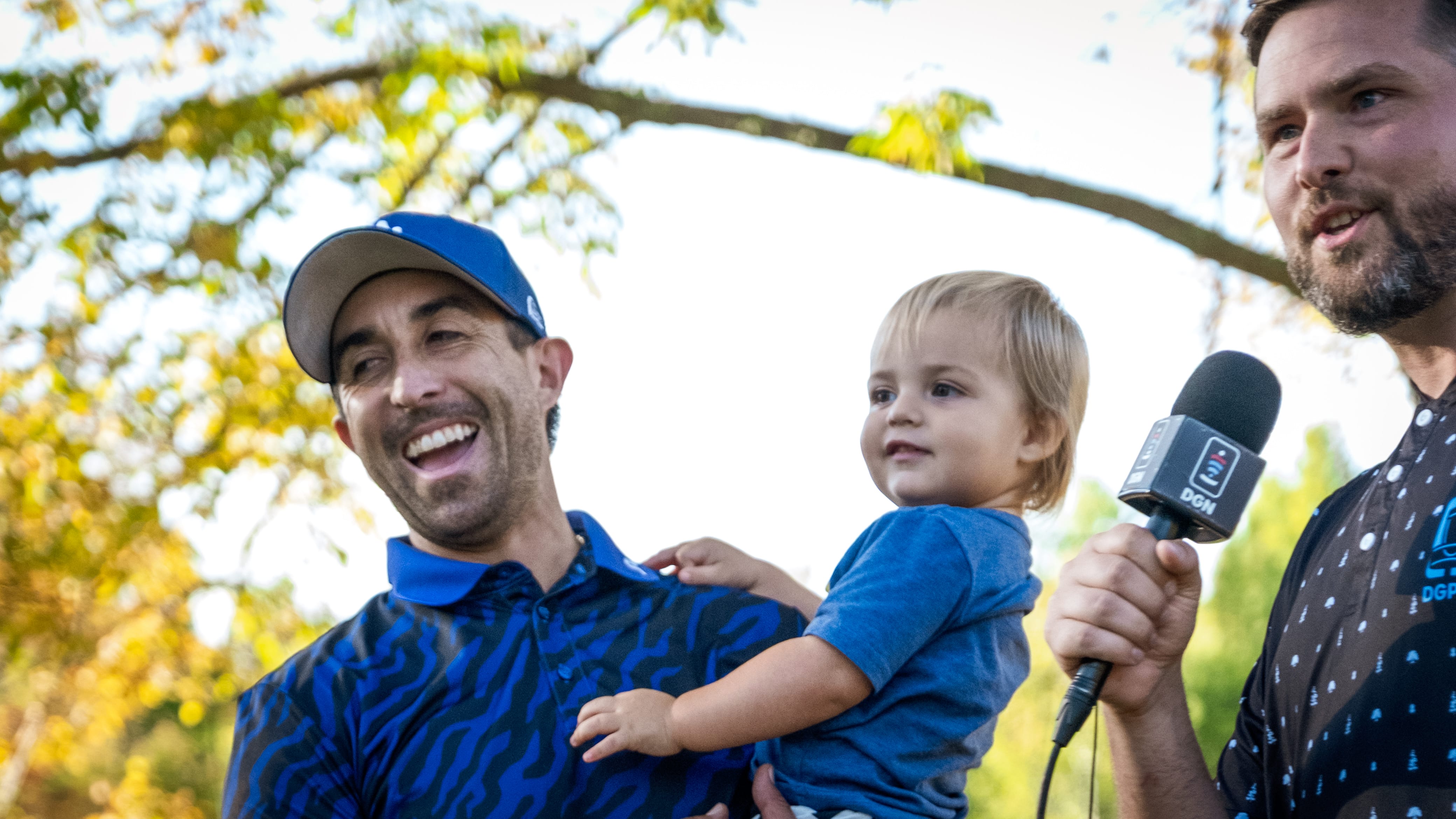
It’s 2025, and Paul McBeth and Paige Pierce are Green Mountain Champions.
The two legends’ recent surge back into prominence has stirred something resembling emotion in the heart of this cynical old disc golf hack. After reflecting on why, I suspect it was because I was there — literally standing right there — when both champions won the first of the 11 world titles they have between them.
I was there on that hot, energy-sapping, mid-July afternoon in Charlotte, NC, in 2012, when I heard ‘McBeth’ echoing through the crowd at the World Championships MPO final 9, as if every second person in that gallery of Charlotte locals was explaining who he was to their friend. I wasn’t much of a fan in those days and hadn’t heard of McBeth. Most of the early buzz had been around local hero Michael Johansen after an 1113-rated 41 at Nevin that had shot him into a 5 stroke lead over Ricky Wysocki and Will Schusterick. McBeth had caught Johansen by round 5, though, and then shot away to a five stroke lead with a 1075-rated 49 in the semifinal at Hornets Nest. The seven stroke cushion going into the final nine made for a victory lap.
I was there the year before, too, on a warm and breezy Central Coast Saturday afternoon to watch a 20-year-old Paige Pierce start the final nine level with adopted hometown favorite Valarie Jenkins, before exploiting a two stroke swing early in the round to pull away and claim her first world title by three strokes. Paige was less of an unknown, though, having already bagged nine wins that year, including the Memorial and the Glass Blown Open.

I’d say they remain such strong memories for me because I haven’t seen any elite series disc golf in the USA since. For me in Perth, Australia, the US is the antipode – the direct opposite to you on the globe as if you’d drilled through the centre of the Earth to get there. I couldn’t get further away from the DGPT without being an astronaut and, aside from the USDGC in 2013 and the inaugural team Worlds in Vancouver in 2016, time and finances have prevented me going back since. What few memories I have tend to loom large.
So to see them both come back to the top if the field in the last weeks and take down DGPT wins took me back to the time I saw them both take their first steps into the limelight.
But that’s my story. Here’s why it will resonate with the wider disc golf world.
For a Generation of Disc Golfers, McBeth is Their Guy
Seeing McBeth up close that first time, I thought his form looked impossibly smooth, and in the following months I found myself unconsciously mimicking him. New disc golfers can be a bit like ducklings or goslings in how they’ll imprint on an elite player: following them online, throwing their discs, wearing their hats & shirts, but, most tellingly from a zoological standpoint, mimicking their mannerisms. I’m unconsciously part of a sect of disc golfers that screw their back foot into the ground before they putt, and I don’t care that Paul doesn’t do it anymore, I’m still doing it.
It wasn’t just that Paul won so much, it was how he won – in style. It was a combination that has sold millions of discs and correspondingly led him to being the sport’s first million dollar athlete. McBeth has done it chiefly on his competitive record, too. Although he has had his forays into YouTube, his following comes mostly from his performance as a player, not as a social media influencer.
For a Generation of Disc Golfers, Pierce is Their Gal
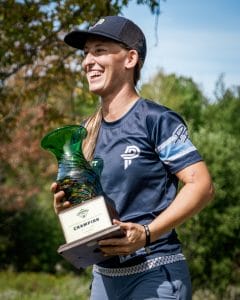
Paige visited my hometown of Perth for the Aussie Open in 2017. I still remember introducing her to a friend of mine who had been playing disc golf for barely a year: I saw that nervous excitement that people only get when they are meeting one of their heroes. Paige has inspired a generation of women to play disc golf and, much like McBeth, her following is largely due to her performance on the course.
Like McBeth, her dropping from the contenders’ conversation in big tournaments has seemed a bit too soon, and I’m glad we are getting another year or three – her fan base is going to need proper closure.
McBeth (and others) are Showing That Chronic Throwing Injuries can be Rehabilitated
I first met Gregg Barsby in the parking lot at DeLaveaga, sitting on the open tailgate of a wagon strewn with boxes of discs, camping gear, and a sleeping bag. So I know there’s always been pros living the touring life. The difference is that we now have a decent sample size. The pro players who are now hitting their mid-thirties after having toured full-time are starting to reveal the injury patterns that go with the throwing life.
McBeth tore the labrum in his throwing shoulder in the final practice round for the 2023 European Open, and it’s only this season that the injury no longer impedes him. Rehabilitating chronic injuries takes patience and the persistence to overcome many setbacks.
The shoulder is an inherently unstable joint. That’s why it’s so easy to dislocate. Structurally, it is like a golf ball on a tee. The labrum is the soft cartilage that extends from around the rim of the socket to help hold the ball in place. Think of the rubber seal covering a universal joint in a car. Tear the labrum and it takes a long time before the body will trust you with putting full load through the shoulder joint again.
Shoulder rehabilitation involves many false dawns and setbacks. It’s good to see a top player come out the other side of it, just as it has been with Gavin Rathbun.
Paige’s Injury Rehab is an Inspiring Story
Before Paige had won the playoff in one hole at the Green Mountain challenge against Ohn Scoggins and Missy Gannon, she chose to run up the hill to the tee of hole 18 instead of taking a cart. If we ever need a symbolic end to a long, rehabilitation process which began with her seriously doubting that she’d ever be able to play again, then that was it.
Even last year, when Paige successfully returned to the tour and managed a win at the Portland Open, it was clear that she wasn’t fully confident in the injured leg. With injuries to the ankle and the knee, after the pain is gone, the strength has mostly returned and the joint is mobile again, the last capacity to return is the sense we call proprioception – the brain’s awareness of where that limb is positioned in three dimensional space. That can sometimes take a year or two to return and can be frustrating for an athlete who is straining at the leash and can’t understand why their leg won’t fully cooperate.
It’s clear that there’s been a huge volume of work that’s gone into Pierce’s return.
Because Older Players Need to Believe
I think it’s good for all players in their 30s and 40s to rage against the dying of the light. We know that disc golf can be a lifelong pursuit. But to think that you peak as a player in your 20s and then it’s all slowly downhill from there takes out just a little bit of the fun. It’d be nice to think that we develop other skills as we evolve from being just a master blaster. Ohn Scoggins has been showing the way in the past few years and showed up big this year. It would be good to see a few more of the dominant MPO players in the past decade have a third act in their career.
Players like McBeth, Ricky Wysocki, and Paige Pierce have travelled some uncharted territory in the sport in the past few years. As their brands and off-course enterprises have grown, the challenge of balancing the demands of this with the amount of practice needed to stay competitive is something that few in the sport before them have had to manage. All three players in recent times have shown signs that they are starting to get the formula right.
It’d be nice to know that great champions never lose their essence: who wouldn’t want to see a few more epic Paul and Ricky or Paige and Catrina battles? To have these champions never contend again would leave a bit of a void. Here’s hoping that they can all step up and bag a big one or two in the next couple of years.